The Château de Barbarin through the centuries
The history of Barbarin can be read in the archives as much as in the stones. The cartulary of the Abbey of Bonnevaux, notarial records, furniture inventories, deeds of sale: every stage of construction and every change of hands is attested. Here we offer you the account, century by century.
12th century: the Abbey of Bonnevaux
In 1185, the Cistercian monks of the Abbey of Bonnevaux, who worked the grange of La Perrière de Primarette, occupied the site. The cartulary of Notre-Dame de Bonnevaux then mentions the Barbarin wood, “…in nemore de Barbarino…”.
14th century: Revel-Barbarin
The first stones of the present building were laid at the beginning of the 14th century. François de Revel and his son Reynaud undertook the construction of this watchtower, whose fief was granted to a younger branch of the family. Set near the castle of its elder branch, it completed a military organisation dominating the plain of the Bièvre Valloire.
Jehan de Barbarin de Revel is the oldest known lord to bear the name of Barbarin.
A trefoil window, a vestige of the former oratory of the Revel-Barbarin family, still bears witness to that era.
15th century: Roussillon and Saussac
In 1441, the fortified house belonged to Marie de Roussillon and her husband Josserand de Saussac, first baron of Velay. The couple enlarged the building by adding a wing and substantial outbuildings forming an upper and a lower courtyard.
It was Marie de Roussillon who commissioned the two great painted rooms. In the upper room, the deed of sale of the parish of Monsteroux was signed by the lord of Milieu, an event from which the commune today takes its name, Monsteroux-Milieu.
In the present dining room, a door lintel reveals the coat of arms of the Saussac family: it is the only known depiction of these arms.
16th century: from the Saussacs to the Émé de Saint Julien
On 25 July 1565, Jean-François de Saussac, lord of Barbarin, acquired the seigneury of Revel, the castle and its land.
On 16 June 1586, Richard Melchior de Saussac sold Barbarin for 12,000 écus to Octavien Émé de Saint Julien (1551–1624), councillor to the King and president of the Parlement of the Dauphiné. These holdings mark the influence of this illustrious family in the lower Dauphiné. It is to him that the castle owes its round tower.
17th century: the Émé de Saint Julien de Marcieu
The lord of Barbarin was then Ennemond Émé de Saint Julien, baron of Marcieu (1605–1670).
An inventory dated 21 January 1640 describes the movable and immovable property, livestock and seed belonging to the fortified house, handed over to the tenant farmer Louis Trouillet for an annual price of 1,500 livres, four hogs and thirty capons.
That same year, his wife Virginie Guiffrey de Monteynard had repairs undertaken: a fixed-price contract dated 12 February 1640 entrusted them to the carpenter Antoine Gautier, of Beaurepaire, for 39 livres. She found the expense excessive!
18th century: from Marcieu to Lamalétie
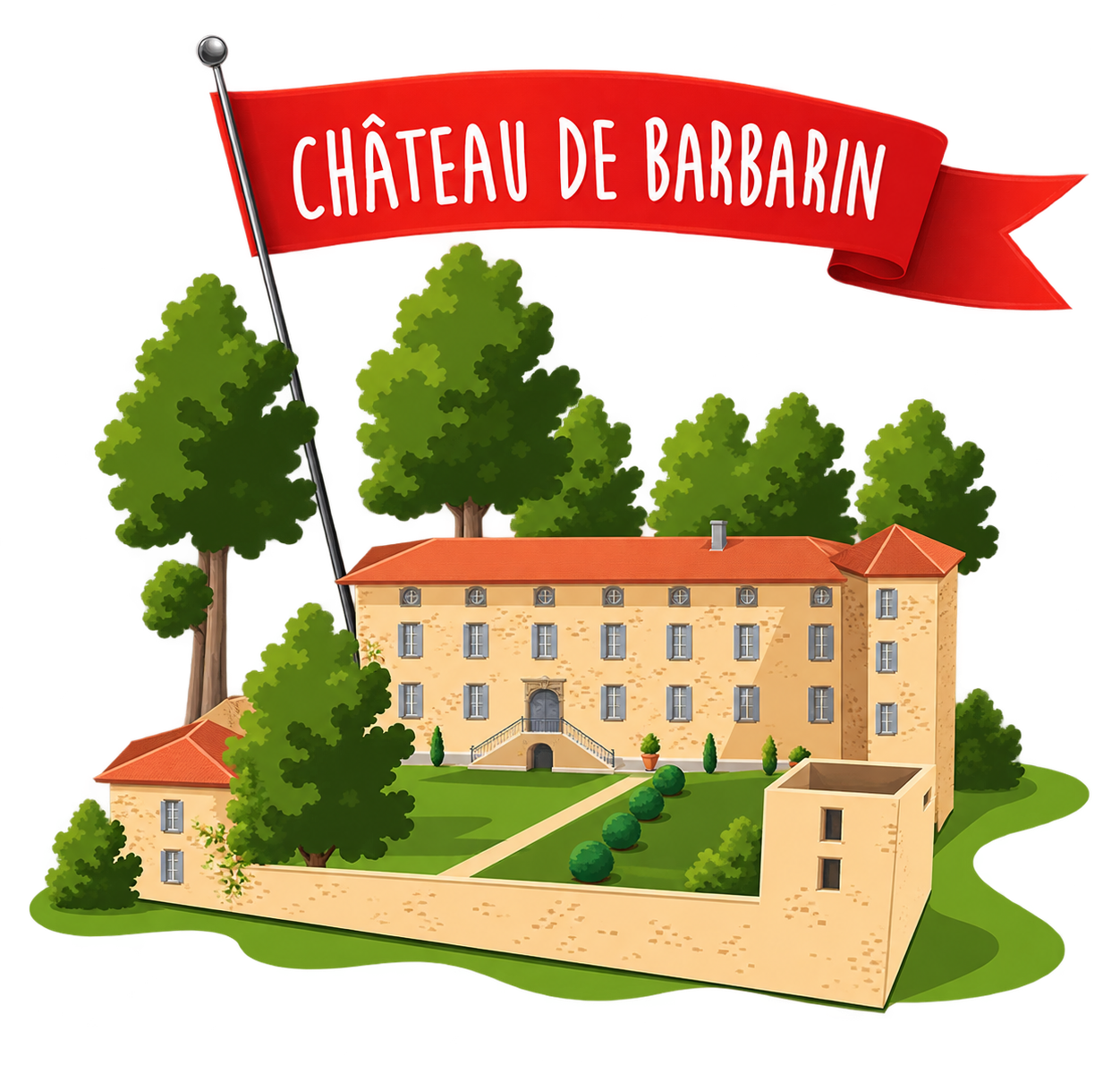
Laurent-Joseph Émé de Saint Julien (1676–1742), second marquis of Marcieu and governor of Grenoble, husband of Gabrielle de Mistral de Montmirail, transformed the fortified house into a residence while he managed his holdings in the southern Vienne area. Its south façade, pierced with twenty-three windows, overlooks a courtyard bordered to the east by the stables; below this terrace stretch the gardens.
On 10 July 1745, after one hundred and fifty-nine years of family ownership, Gabrielle de Mistral de Montmirail, the marquis’s widow, sold Barbarin for 50,000 livres to Pierre-Hilaire de Lamalétie, knight and treasurer-general of France in the généralité of the Dauphiné.
The status of the fief of Barbarin
A lawsuit deliberated in Paris on 22 June 1767 established the singularity of the fief: entirely independent of the seigneury of Revel, it was held solely from the High Domain of the Crown. Revel, by contrast, was merely a sub-fief of the archbishops of Vienne — and even owed dues to the lord of Barbarin.
The Revolution
No looting was reported at Barbarin. On 1 August 1789, the municipality of Beaurepaire wrote to that of Moras: “Gentlemen, Revel at this moment requests help for themselves and for Barbarin; we are setting off, come and join us at Barbarin…”
19th century: Luzy de Pélissac and Barrin de Champrond
When the estate was sold, a detailed inventory described the castle and its furnishings. In the dining room with its stucco-work one notes “a dozen soup plates, four dozen plates, eight Strasbourg faience compotiers, four blue printed-cotton window curtains…” — a total of 108 plates and some thirty serving pieces. The notary proceeded room by room: today one finds exactly the same layout, and the dining room has kept its stucco-work.
The estate was acquired by François-Aimé de Luzy, marquis of Pélissac (1796–1851). A major landowner, soldier, bodyguard of King Louis XVIII and then mayor of Revel, he had only daughters. To him we owe the stables at the rear of the castle as well as the farm adjoining the barn to the east.
In 1874, Baron Léon-Émilien de Barrin de Champrond (1829–1902) and his wife settled at Barbarin, managing several hundred hectares and numerous farms. A local text reports that his horse is buried in front of the castle.
20th and 21st centuries: the safeguarding
Baron Joseph de Barrin de Champrond owned Barbarin at the start of the 20th century. On his death, on 17 May 1923, Baroness Jacqueline de Barrin, née de Mauléon Narbonne, bequeathed the estate to her son Joseph de Barrin (1915–1998).
In 1984, he sold the castle — and the castle alone — to Christophe Effantin. For the first time since the 14th century, the building was separated from the estate from which it had been inseparable.
On 29 May 1993, the badly dilapidated castle was sold to Philippe Seigle.
On 6 June 2003, the acquisition of the farm, the barn, the outbuildings and part of the land finally restored the ensemble’s coherence. Its restoration and upkeep are today the responsibility of the Seigle-Paillet family, owners of the estate, which is protected as a Historic Monument.
Historical sources: The history of Barbarin draws on identified archival sources: the cartulary of Notre-Dame de Bonnevaux, the Departmental Archives of the Isère (series B, E, G and 3E), the communal archives of Beaurepaire, and the private archives of the de Luzy and de Barrin de Champrond families.
Experience the Château de Barbarin
Guided tours, guest rooms or concerts: contact us directly to plan your visit in the heart of the Isère.